


The Reserve Bank of India has raised its benchmark repo rate by 25 basis points to 5.50%, marking its first rate increase in nearly four years. The decision, announced on October 7, 2026, came as the central bank responded to rising inflationary pressures, higher oil prices and a challenging global environment. The six-member Monetary Policy Committee voted unanimously for the increase and shifted its policy stance from “neutral” to “calibrated tightening.” For ordinary households, however, the bigger question is not the repo rate itself. It is what happens to home loan EMIs, personal loans, car loans, fixed deposits and household savings. The answer will depend on how banks and financial institutions transmit the rate change to their customers..
What Is the Repo Rate?

The repo rate is the interest rate at which the RBI lends money to banks against eligible securities. When the RBI raises the repo rate, borrowing from the central bank becomes more expensive for banks. This can eventually influence lending and deposit rates across the financial system. However, a 25-basis-point repo rate increase does not automatically mean that every loan EMI will rise by exactly 0.25 percentage points immediately. The actual impact depends on the type of loan, the lender's benchmark, the interest-rate reset mechanism and the timing of the reset..
Home Loan Borrowers: Will EMIs Increase?
Floating-rate home loan borrowers are likely to be among the first consumers to watch the RBI's decision closely. For loans linked to an external benchmark, changes in the benchmark can be transmitted relatively quickly. But the exact impact on a borrower's EMI or loan tenure depends on the lender's terms..
A borrower may therefore see:-
- A higher EMI while the loan tenure remains broadly unchanged..
- A longer repayment period if the lender keeps the EMI unchanged..
- A combination of a higher EMI and a longer tenure.
- No immediate change if the particular loan's reset mechanism does not pass through the increase at that point..
The effect can also differ between borrowers because existing loans may carry different interest rates and benchmark arrangements..
Home Loan EMI Example: How Much Could It Change?
Consider a ₹50 lakh home loan for 20 years. Assume, purely for illustration, that the interest rate before the change is 8.50% and the lender eventually passes the full 25-basis-point increase through, taking the rate to 8.75%..
At 8.50%, the approximate EMI would be ₹43,391 per month..
At 8.75%, the approximate EMI would rise to about ₹44,186 per month..
That is an increase of roughly ₹794 per month. Over a full year, that difference would be approximately ₹9,528, assuming the loan balance and rate remained unchanged and the entire increase were reflected in the EMI. These numbers are illustrative only. Actual EMIs can be different because lenders use different rates, reset dates, loan balances and repayment structures. A borrower should check the revised rate and repayment schedule provided by their lender rather than relying on a generic calculation..
Another Example
Suppose someone has a ₹30 lakh loan for 15 years, with the interest rate moving from 8.50% to 8.75%. Under the same assumptions, the EMI would rise from approximately ₹29,542 to ₹29,983.
That is a difference of around ₹441 a month. The examples show why a 25-basis-point change can look small at the headline level but still matter over a long loan period..
What About Personal and Car Loans?

The impact is not limited to home loans. Borrowers with floating-rate personal, vehicle or business loans could also face higher borrowing costs if their lending rates are revised following the RBI's move. The impact will depend on whether the loan is fixed or floating and on the benchmark used by the lender..
Borrowers should therefore check three things:-
- What benchmark is linked to the loan?
- When is the next interest-rate reset?
- Will the lender change the EMI, the tenure or both?
For someone planning to take a new loan, the rate hike could also mean a slightly higher starting interest rate than would have been available under unchanged monetary conditions..
Could Fixed Deposit Rates Go Up?
A repo rate hike can also be relevant for savers. Banks compete for deposits to fund their lending activities. If funding conditions tighten, some banks may increase deposit rates to attract or retain customers. That means FD rates could move higher, although there is no guarantee that every bank will immediately raise rates by 25 basis points. The response can also differ by deposit tenure and bank. For savers, the environment may therefore become somewhat more favourable than it is for borrowers if deposit rates rise while lending rates also move higher. However, investors should compare the complete interest rate, tenure, premature-withdrawal rules and taxation rather than choosing an FD only because its headline rate is higher..
Why Did the RBI Raise Rates?
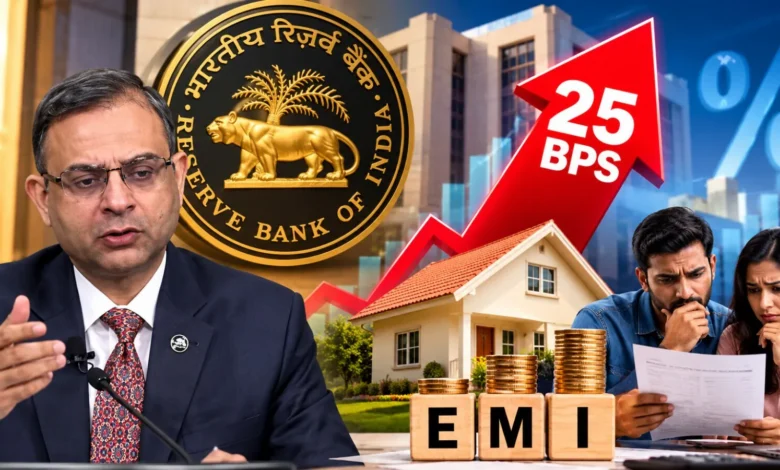
Inflation has become a growing concern for the central bank. Reuters reported that India's consumer inflation accelerated to 4.82% in August, remaining above the RBI's 4% medium-term target. Higher oil prices, food costs and a weaker currency have added to concerns about future price pressures. The October rate decision also came against a backdrop of higher crude prices and global economic uncertainty. The RBI raised its FY2026-27 inflation forecast to 5.2%, while also increasing its growth forecast to 7.1%, according to reports on the October policy decision. In simple terms, the RBI is trying to prevent higher costs from becoming more persistent while the economy continues to grow strongly..
September 2026 Inflation: What Economists Are Expecting

There is another important inflation development to watch. A Reuters poll of 41 economists estimated that India's September 2026 consumer inflation could rise to around 5.4%, compared with 4.82% in August. The economists cited higher food and energy costs among the factors likely to have pushed inflation higher. However, this figure should not be treated as the official September inflation reading until the government's final CPI data is released. Other economist surveys have produced somewhat different estimates. For example, a Financial Express poll of 13 economists put the expected September inflation rate at around 5.6%. The difference between these surveys is a useful reminder that these are forecasts, not confirmed government data. The official CPI number will provide the final picture..
What Does Higher Inflation Mean for Borrowers?

Higher inflation can affect household finances in several ways. When food, fuel, transport and other everyday costs rise, households have less disposable income available for loan repayments and savings. For borrowers, this creates a double pressure: living costs may increase at the same time that borrowing costs become more expensive. A household with a large floating-rate home loan may therefore want to review its monthly budget before assuming that a small change in interest rates will have little effect..
Should Existing Home Loan Borrowers Prepay?
A rate hike may encourage some borrowers to consider partial prepayment. But there is no universal answer. If a borrower has surplus cash after maintaining an emergency fund and meeting other financial goals, reducing a high-interest loan can lower future interest costs. At the same time, using all available savings to prepay a loan may leave a household without enough liquidity for emergencies..
Before making a decision, borrowers should consider:-
- Current loan interest rate.
- Outstanding principal.
- Remaining tenure.
- Emergency savings.
- Tax implications, where applicable.
- Alternative uses for the money.
- Any applicable lender terms or charges.
The right choice depends on the individual's financial position rather than the RBI rate alone..
What Should FD Investors Do?

Existing FD holders should first check whether their deposit is already locked into a fixed rate. A rate increase generally does not mean an existing fixed-rate FD will suddenly start paying a higher rate. For new deposits or deposits coming up for renewal, however, savers may have an opportunity to compare the rates being offered by different banks. Instead of moving money immediately, investors can consider FD laddering — spreading deposits across different maturities so that money becomes available periodically for reinvestment. This can provide greater flexibility if deposit rates continue to change.
What Does the Rate Hike Mean for the Economy?
A higher repo rate is intended to make financial conditions tighter. That can discourage some borrowing and spending, which may help reduce demand-driven price pressures. But higher rates can also increase financing costs for businesses and consumers. The RBI therefore has to balance two competing objectives: keeping inflation under control while avoiding unnecessary damage to economic growth. The October decision suggests that inflation has become important enough for the central bank to begin tightening policy again, even as economic growth remains relatively strong..
What Borrowers Should Check Now
If you have a floating-rate loan, do not wait for the next EMI debit to find out what has changed.
Check your lender's latest communication and look for:-
Revised interest rate:- Has the rate on your loan changed?
Reset date:- When will the new rate become effective?
EMI or tenure:- Is the lender increasing your monthly payment, extending the tenure or doing both?
Outstanding principal:- The impact of a rate change is different at different stages of the loan.
Prepayment options:- If the higher rate significantly affects your finances, check whether partial prepayment could make sense for you..