


The year 1857 marked a major turning point in the history of British rule in India.
What began as a military uprising by Indian soldiers of the East India Company quickly spread to several important centres across northern and central India. Delhi, Kanpur, Lucknow, Jhansi, Bareilly and other regions became major centres of resistance. The uprising involved more than soldiers. In different areas, rulers, zamindars, peasants and sections of the civilian population also joined or supported the rebellion. The revolt was eventually suppressed by the British, but its consequences were far-reaching. In 1858, the British Crown took direct control of India from the East India Company, fundamentally changing the structure of colonial rule..
Why Did the Revolt of 1857 Happen?

There was no single reason behind the uprising. Anger had been building for years because of political expansion, economic pressure, military grievances and fears about social and religious interference. The controversy over the new Enfield rifle cartridges became the immediate trigger, but it was only one part of a much larger crisis..
1. Political Causes
The East India Company had expanded its control over large parts of the Indian subcontinent through wars, treaties and annexations. The annexation of Indian states created resentment among rulers, royal families and sections of the aristocracy. The Doctrine of Lapse, associated with Lord Dalhousie, allowed the Company to annex certain princely states where the ruler died without a natural male heir recognised under the Company's policy. States such as Jhansi, Satara and Nagpur were affected by this expansionist policy. The annexation of Awadh in 1856 created another major source of discontent. The British justified the takeover on administrative grounds, but it disrupted the existing political and social order and affected rulers, soldiers, landlords and other groups. The government's territorial expansion therefore created a large pool of political resentment..
2. Economic Causes
British rule had also changed the economic structure of many parts of India. Revenue demands placed pressure on cultivators, while changes in land administration affected landlords and traditional landholders. The expansion of Company rule also disrupted established economic relationships. In several areas, peasants and landholders had reasons to oppose British policies, while artisans and sections of the traditional economy faced increasing competition and disruption. The result was widespread economic dissatisfaction in regions where the uprising later gained strength. Government historical records identify land revenue and economic exploitation among the important factors behind the unrest..
3. Military Causes
Indian soldiers, known as sepoys, formed a major part of the East India Company's army. However, they faced a number of grievances related to pay, service conditions, discipline and treatment by British officers. The army was also being reorganised along European lines, with greater emphasis on drill and discipline. NCERT notes that these changes sometimes came into conflict with the caste and community identities of Indian soldiers. The growing perception that British military policies did not respect Indian customs added to the tension within the army.
4. Religious and Social Fears
Another important factor was the fear among sections of Indian society that British rule would interfere with their religious and social practices. Rumours about forced religious conversion circulated during this period, creating further suspicion of British intentions. The government's introduction of social and legal reforms was interpreted differently by different sections of society. While some reforms had supporters, others feared that traditional customs and religious identities were under threat. These anxieties became particularly powerful when combined with existing political and economic grievances..
5. The Enfield Rifle Cartridge Controversy
The immediate trigger of the revolt was the controversy surrounding the cartridges used with the new Enfield rifle. Sepoys were required to bite open the cartridge before loading it. A widespread rumour claimed that the cartridges were greased with cow and pig fat. For Hindu soldiers, the cow was sacred, while pork was prohibited in Islam. The rumour therefore created serious religious concerns among both Hindu and Muslim soldiers. Whether every cartridge actually contained the substances alleged in the rumours is a separate historical question. What mattered at the time was that the belief spread rapidly among the troops and intensified already existing distrust of the British. The cartridge controversy turned accumulated resentment into open resistance..
How Did the Revolt Begin?
The unrest among sepoys had already appeared at several places before the major uprising at Meerut. Mangal Pandey, a sepoy at Barrackpore, became one of the earliest well-known figures associated with the rebellion. On 29 March 1857, he attacked British officers during the growing tension over the cartridges. He was later executed. The decisive outbreak came at Meerut on 10 May 1857. Indian soldiers rebelled, released imprisoned comrades and moved towards Delhi. The rebels entered Delhi and declared the ageing Mughal emperor Bahadur Shah II, popularly known as Bahadur Shah Zafar, as their symbolic leader. From Delhi, the uprising spread to several important centres..
Major Leaders of the Revolt of 1857
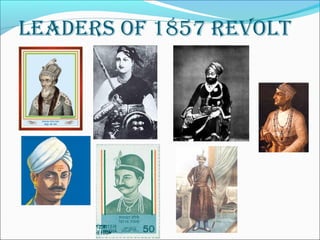
The uprising did not have one central commander controlling every region. Different areas had their own leaders and centres of resistance.
Bahadur Shah Zafar — Delhi
Bahadur Shah Zafar, the last Mughal emperor, became the symbolic head of the uprising after the rebels reached Delhi. His association gave the rebellion a political symbol and connected the uprising with the old Mughal authority. Delhi became one of the most important centres of the revolt. The British eventually recaptured the city in September 1857..
Rani Lakshmibai — Jhansi
Rani Lakshmibai became one of the most prominent figures of the uprising. Jhansi had been annexed under the Doctrine of Lapse after the British refused to recognise her adopted son as the successor to the throne. During the revolt, she emerged as a major leader of resistance in central India and became one of the enduring symbols associated with 1857..
Nana Sahib — Kanpur
Nana Sahib was an important leader of the uprising at Kanpur. He was associated with the former Maratha Peshwa's family and had a political grievance against the British over the continuation of the pension arrangements associated with Peshwa Baji Rao II. Kanpur became one of the major centres of fighting during the revolt..
Tantia Tope — Central India
Tantia Tope was one of the most important military commanders associated with the rebellion. He worked closely with Nana Sahib and later continued resistance in central India. He became particularly known for mobile warfare and continued fighting against British forces even after several major rebel centres had fallen..
Begum Hazrat Mahal — Lucknow
In Awadh, Begum Hazrat Mahal played a major role in organising resistance after the annexation of the kingdom. She supported her son Birjis Qadr, who was proclaimed ruler of Awadh, and became a prominent leader of the resistance in Lucknow..
Kunwar Singh — Bihar
Kunwar Singh, a zamindar and local ruler from Bihar, became one of the important leaders of the revolt in the region. Despite his advanced age, he participated actively in the fighting and continued resistance against British forces. The uprising under Kunwar Singh also reached areas such as Azamgarh before British forces eventually regained control.
Other Important Figures
The revolt also involved several other regional leaders and commanders, including Bakht Khan, Rao Tula Ram and Surendra Sai.
Rao Tula Ram led resistance in the Rewari region, while Surendra Sai played an important role in the uprising in Sambalpur.
Major Centres of the Revolt

The uprising spread across a large part of northern and central India.
Important centres included:-
- Delhi
- Meerut
- Kanpur
- Lucknow
- Jhansi
- Bareilly
- Bihar
- Central India
- Parts of Rajasthan
- Parts of present-day Madhya Pradesh and Haryana
The intensity and character of the uprising varied from region to region. Some areas saw major military confrontations, while others witnessed local rebellions against British authority.
Why Did the Revolt of 1857 Fail?

Despite its scale, the revolt could not remove British rule. One important reason was the lack of a unified command and a common political programme across all the areas involved. The rebellion also did not spread uniformly across the entire subcontinent. Several princely states, communities and military units did not join the uprising, while some groups supported the British. The British also had access to organised military resources and were able to bring reinforcements and regroup their forces. Once Delhi, Lucknow, Kanpur and other major centres were gradually recaptured, organised resistance weakened. Fighting continued in several areas into 1858, but the main uprising had been suppressed..
Consequences of the Revolt of 1857

Although the revolt failed militarily, it produced major political changes..
1. End of East India Company Rule
The most important consequence was the end of the East India Company's rule. The Government of India Act, 1858 transferred authority over India from the East India Company to the British Crown. India was thereafter governed directly on behalf of the British monarch.
2. Beginning of the British Raj
The transfer of power marked the beginning of the period commonly known as the British Raj. The Governor-General of India also became the Crown's principal representative, commonly referred to as the Viceroy. This created a new administrative structure for British rule in India.
3. Changes in the Army
The British reorganised the Indian army after the uprising. The proportion of British troops was increased relative to Indian soldiers, while recruitment patterns were also changed. The British government became particularly concerned about preventing another large-scale military rebellion.
4. A Different Approach Towards Indian Princes
The British became more cautious about annexing princely states. The post-1857 policy sought greater cooperation from rulers who remained loyal or neutral during the uprising. This represented a significant change from the aggressive expansionist policies associated with the earlier period of Company rule.
5. Greater Political and Social Impact
The revolt also left a lasting impact on Indian political consciousness. Although the uprising did not create a unified modern nationalist movement in the later sense, its memory became an important part of India's anti-colonial history. Later generations remembered figures such as Rani Lakshmibai, Mangal Pandey, Bahadur Shah Zafar, Nana Sahib, Tantia Tope and Kunwar Singh as symbols of resistance. Government historical resources describe the uprising as a major turning point in the freedom struggle.
Was 1857 the First War of Independence?
The uprising is commonly described in India as the First War of Independence, while British-era accounts often referred to it as a sepoy mutiny or rebellion. Modern historical interpretations recognise that the uprising began among soldiers but quickly involved civilians, peasants, local rulers and other groups in several regions. At the same time, participation was not uniform across India, and the uprising did not represent a single centrally organised national movement in the modern sense. This makes 1857 a complex historical event whose character has been interpreted differently by historians. Government historical resources themselves note both its military origins and its wider participation..
The Historical Significance of 1857

The Revolt of 1857 did not end British rule in India. But it changed the nature of that rule. It exposed the depth of resentment against the East India Company and forced the British government to reconsider its military, political and administrative policies. Most importantly, the uprising marked the end of Company rule and the beginning of direct Crown rule. For Indian history, 1857 also became an enduring reference point in the development of resistance to colonial rule.. The Revolt of 1857 was the result of years of political, economic, military and social tensions. The annexation of Indian states, economic pressure, military grievances and fears over religious interference created a volatile environment. The Enfield cartridge controversy then provided the immediate spark. From Meerut and Delhi, the uprising spread to major centres such as Kanpur, Lucknow, Jhansi and Bihar, where leaders including Bahadur Shah Zafar, Rani Lakshmibai, Nana Sahib, Tantia Tope, Begum Hazrat Mahal and Kunwar Singh played important roles. The rebellion was eventually suppressed, but its consequences were historic: East India Company rule ended in 1858, the British Crown took direct control of India, and the structure of colonial rule was fundamentally reshaped. The Revolt of 1857 therefore remains one of the most important turning points in the history of modern India...