


Jantar Mantar in New Delhi has undergone a significant transformation over the course of nearly three centuries. Originally built as an astronomical observatory, this historic site later evolved into one of the most prominent venues in India for public demonstrations, hunger strikes, and movements advocating for political and social change.However, in October 2026, Jantar Mantar became a subject of discussion for a different reason: the Delhi Police removed it from the list of officially designated protest sites and selected alternative locations for such demonstrations. This decision has raised legal questions regarding the future of public protests in the national capital.According to media reports, on October 15, 2026, the Supreme Court issued notices to the Central Government and the Delhi Police concerning the removal of Jantar Mantar from the list of designated protest sites. The matter is currently under legal scrutiny.
So, what is the history of Jantar Mantar? Who built it and why, and how did this 18th-century scientific monument eventually become a symbol of public protest?
Jantar Mantar Latest News 2026: What Has Changed?
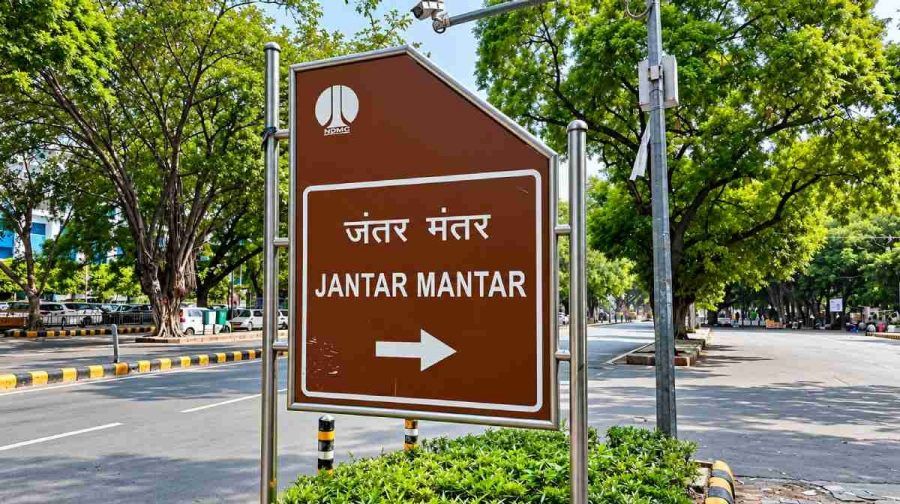
On October 12, 2026, Delhi Police announced that Jantar Mantar would no longer be a designated location for protests and demonstrations. Three alternative venues were identified: Ramlila Ground in central Delhi, Burari Ground in north Delhi and CBD Ground in east Delhi.
The change followed recommendations from a committee constituted by the Ministry of Home Affairs to examine alternative locations for public demonstrations. Delhi Police subsequently referred to the change before the Delhi High Court.
The development marks a major shift for a place that had become closely associated with public movements over several decades.
On October 15, reports said the Supreme Court had issued notice to the Centre and Delhi Police in connection with a challenge to the decision. This means the broader question of access to the historic site for demonstrations remains contested.
The change in designation should not be confused with the closure or removal of the historical monument itself. Jantar Mantar remains an important heritage landmark; the recent decision concerns its official status as a protest venue.
Why it matters: The debate is about how authorities should balance public order, traffic management and security with citizens' ability to gather peacefully and express their views.
Sources: The Indian Express report on the denotification and The Times of India report on the change.
Who Built Jantar Mantar and Why?

Jantar Mantar in Delhi was built under the patronage of Maharaja Sawai Jai Singh II, the ruler of Amber and the founder of Jaipur. Construction of the Delhi observatory began in the early 18th century, generally dated to 1724.
Jai Singh II had a strong interest in astronomy and mathematical observation. At the time, astronomical calculations were important for calendars, timekeeping, celestial observations and astrological predictions.
He commissioned a series of observatories at different locations, including Delhi, Jaipur, Ujjain, Mathura and Varanasi. These sites were designed to help observers study the positions and movements of celestial bodies using large, carefully constructed instruments.
Rather than relying only on small handheld instruments, the observatories used monumental masonry structures. Their size and geometry helped observers make measurements with the naked eye.
Jantar Mantar in Delhi is therefore a reminder of India's scientific and architectural history, as well as the relationship between astronomy, royal scholarship and the practical needs of society in the 18th century.
What Does the Name Jantar Mantar Mean?

The name is commonly explained as a variation of words associated with instruments and calculations.
The term is linked to the Sanskrit-derived word yantra, meaning an instrument or device, and mantra, a term associated with calculation or formula in this context. The name reflects the site's original purpose: using instruments to make astronomical measurements.
Although the spelling and popular explanations vary, Jantar Mantar is widely understood as a place associated with astronomical instruments and observation.
What Is Special About Jantar Mantar?
Jantar Mantar is unusual because its scientific instruments are also monumental architectural structures. Built from masonry, stone and other materials, they were designed to measure time, track celestial positions and support astronomical calculations.
Important instruments at the Delhi observatory include:
1. Samrat Yantra
The Samrat Yantra is a large sundial-like instrument. Its massive triangular structure and carefully aligned surfaces help observers determine local solar time and study the Sun's apparent movement.
Its design demonstrates how geometry and architecture could be combined to make astronomical measurements.
2. Jai Prakash Yantra
The Jai Prakash Yantra consists of bowl-shaped structures with markings that help observers determine celestial coordinates. The instrument was designed to support observations of the positions of celestial bodies.
It is one of the observatory's distinctive examples of astronomical measurement translated into physical form.
3. Ram Yantra
The Ram Yantra uses cylindrical arrangements and marked surfaces to help measure the altitude and azimuth of celestial objects. These measurements describe how high an object appears in the sky and its direction relative to the observer.
4. Misra Yantra
The Misra Yantra is a collection of structures designed for different astronomical calculations. Its components reflect the observatory's role as a working scientific facility rather than simply a ceremonial monument.
Together, these instruments illustrate the ingenuity of pre-modern astronomical engineering.
How Did Jantar Mantar Become Delhi's Famous Protest Site?
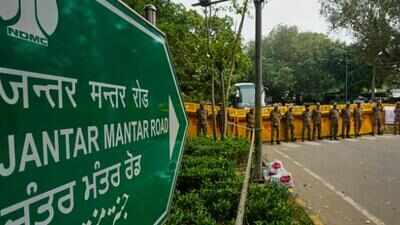
Jantar Mantar was not originally built for demonstrations. Its transformation into a major protest venue took place much later, as Delhi's public spaces and rules governing demonstrations evolved.
For years, the Boat Club area near India Gate and the government district was a prominent location for demonstrations. As restrictions and security arrangements changed, Jantar Mantar increasingly became an important venue for organised public gatherings.
Its central location made it accessible to campaigners, workers, students, civil society groups and political organisations. It was also close enough to important government institutions to give demonstrations visibility.
Over time, a place created for observing the sky became a location where people sought to draw the country's attention to events on the ground.
The change was gradual, shaped by public movements, policing arrangements and the practical challenge of accommodating protests in a busy capital.
Major Protests Associated With Jantar Mantar
Jantar Mantar has hosted demonstrations on a wide range of social, political and civic issues. Several movements helped establish its national profile.
Anna Hazare's Anti-Corruption Movement, 2011
One of the most prominent events associated with Jantar Mantar was Anna Hazare's hunger strike in April 2011. The movement demanded stronger anti-corruption legislation and a Lokpal mechanism.
The campaign attracted significant public attention and became part of a wider national debate about corruption, accountability and governance. It also helped bring several activists into the national political spotlight.
Justice for Nirbhaya, 2012
Following the December 2012 Delhi gang rape and assault case, public anger led to widespread demonstrations demanding justice and stronger protections against sexual violence.
Jantar Mantar became one of the places associated with the broader public response, alongside protests at other locations in the capital.
Protests Over Arunachal Student Nido Tania's Death, 2014
Demonstrations following the death of Nido Tania, a student from Arunachal Pradesh, drew attention to racism and discrimination faced by people from India's northeastern states.
The campaign highlighted concerns about safety, prejudice and equal treatment in metropolitan cities.
Tamil Nadu Farmers' Protest, 2017
Farmers from Tamil Nadu held a prolonged protest in Delhi in 2017, demanding relief for agricultural distress, debt-related assistance and action on water-related concerns.
Their demonstrations drew attention to the financial difficulties faced by farmers and the challenges of bringing regional agricultural issues to the national political agenda.
Wrestlers' Protest, 2023
Jantar Mantar was also the centre of a major wrestlers' protest in 2023. Prominent Indian wrestlers, including Vinesh Phogat, Sakshi Malik and Bajrang Punia, joined demonstrations involving allegations of sexual harassment against the then Wrestling Federation of India chief.
The protest received national attention and raised questions about athlete safety, institutional accountability and the treatment of women in sport.
These examples help explain why Jantar Mantar became more than a historical monument. For many people, it represented a visible place to raise concerns in public.
Why Was Jantar Mantar Removed as an Official Protest Site in 2026?
The October 2026 decision has renewed the debate over how protests should be managed in Delhi.
Authorities have pointed to the need for alternative venues and more suitable arrangements for demonstrations. Large gatherings in central Delhi can create challenges involving traffic, crowd management, security and access to nearby government offices.
The newly designated locations announced by Delhi Police are Ramlila Ground, Burari Ground and CBD Ground.
However, critics of restrictions on protest venues argue that location matters. A central site can make a demonstration more visible and provide easier access for participants, journalists and members of the public.
The legal challenge also raises a broader question: how should the right to peaceful assembly be balanced against reasonable restrictions intended to protect public order?
The Supreme Court's notice reported on October 15 means the issue should not be treated as finally settled. The precise legal position and any subsequent directions depend on further proceedings and official orders.
Does This Mean Protests at Jantar Mantar Have Ended?
The distinction between the end of an official designation and the end of public protest is important.
Delhi Police's decision means Jantar Mantar is no longer on the list of designated protest venues under the revised arrangements. It does not mean that public demonstrations or political dissent have ended across Delhi.
Nor does the decision, by itself, establish that every gathering at Jantar Mantar is automatically unlawful in all circumstances. Permissions, applicable orders, court directions and the facts of a particular event matter.
Visitors and organisers should check current police instructions before planning any gathering at the site. For updates on the ongoing legal challenge, follow reliable reporting and official court or police communications.
Jantar Mantar as a Historical Monument
Despite the recent controversy, Jantar Mantar remains an important heritage site.
Its instruments provide insight into the astronomical knowledge, mathematical techniques and architectural experimentation of the early 18th century. They also help visitors understand how scientific observation was carried out before modern electronic instruments and telescopes became widespread.
The Delhi observatory is distinct from the larger and better-preserved Jantar Mantar in Jaipur, which is recognised as a UNESCO World Heritage Site. Both belong to the same broader tradition of observatories commissioned by Jai Singh II.
Visitors should remember that Jantar Mantar is first and foremost a protected historic monument. The observatory's architectural and scientific significance exists independently of its more recent role in public demonstrations.
How to Visit Jantar Mantar in Delhi
Jantar Mantar is located in central New Delhi, close to Connaught Place and major transport links.
- Nearest metro area: Rajiv Chowk and Patel Chowk are commonly used options, depending on your route and walking preference.
- Best time to visit: Mornings or late afternoons can be more comfortable for exploring the outdoor structures, depending on the weather.
- What to see: The Samrat Yantra, Jai Prakash Yantra, Ram Yantra and other surviving astronomical structures.
- Before you go: Check current opening hours, entry fees, visitor rules and any temporary restrictions through official monument information.
Because the site's protest designation has changed, do not assume that access rules for demonstrations and visitor access to the monument are the same.