


Few monuments in India have been connected to as many chapters of the country's history as the Red Fort in Delhi.
Known popularly as Lal Qila, the massive red sandstone fort began as the palace fort of Mughal emperor Shah Jahan's new capital, Shahjahanabad. Construction began in the 17th century, and the complex became the centre of Mughal political and ceremonial life in Delhi. But the story of the Red Fort did not end with the decline of the Mughal Empire. The fort witnessed invasions, political changes, the upheaval of 1857 and the transformation of Delhi under British rule. In independent India, it acquired an entirely different meaning: every year on August 15, the Prime Minister raises the national flag from the fort's ramparts and addresses the country. That journey—from imperial palace to national symbol—is what makes the Red Fort's history particularly significant..
Who Built the Red Fort?

The Red Fort was commissioned by Mughal emperor Shah Jahan, the fifth Mughal emperor and the ruler associated with some of the most famous monuments of Mughal architecture. Shah Jahan decided to move his capital from Agra to Delhi and establish a new imperial city known as Shahjahanabad. The Red Fort was designed as the palace fort at the heart of this new capital. Construction began in 1638–39 and was completed in 1648. Government and UNESCO sources identify the fort as the palace fort of Shahjahanabad and describe its planning as a major achievement of Mughal architecture. The fort was originally known as Qila-i-Mubarak, meaning the Blessed Fort, according to Delhi's Shahjahanabad heritage documentation..
Why Is It Called the Red Fort?

The name comes from the enormous red sandstone walls that surround the complex. The fort's imposing exterior was designed to communicate strength and authority, while the interiors contained elegant marble halls, gardens, pavilions and private royal apartments. UNESCO notes that the massive red sandstone walls are one of the defining characteristics of the Red Fort Complex. The contrast between the defensive-looking exterior and the richly decorated palace interiors was an important part of the monument's design..
The Red Fort and Shahjahanabad

The Red Fort was not built as an isolated monument. It was the centrepiece of Shah Jahan's new imperial capital, Shahjahanabad. The fort stood beside the Yamuna and was integrated into the city's larger urban design. The location was significant because the Yamuna was closely connected to the fort's original landscape and water system. The river also supplied water for parts of the complex, including the channels that flowed through the palace areas. The city that grew around the fort eventually developed into what is now known as Old Delhi..
The Architecture of the Red Fort
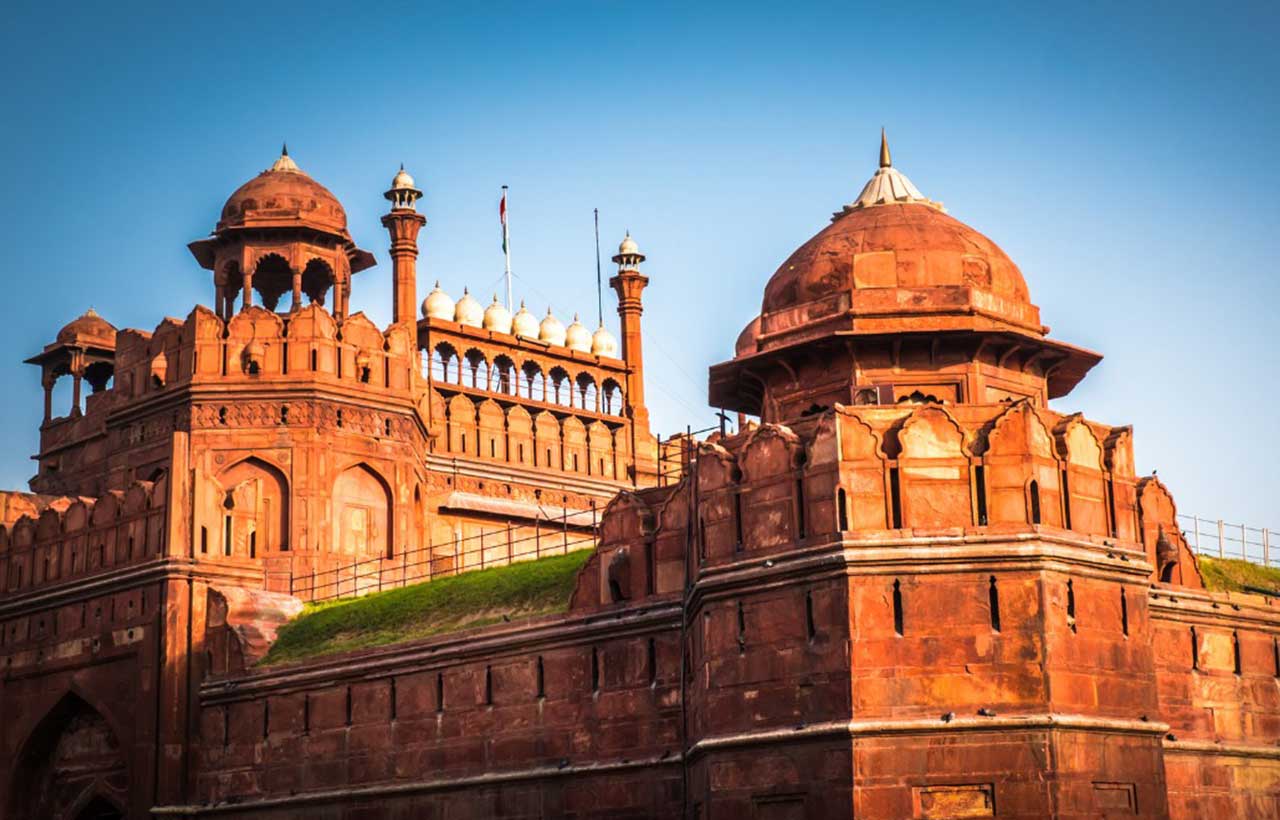
The Red Fort is one of the finest examples of mature Mughal architecture. Its design combines influences from Islamic, Persian, Timurid and Hindu traditions, creating an architectural style that was both imperial and distinctly Indian. UNESCO describes this fusion as one of the major reasons for the fort's outstanding universal value..
The complex included:-
- Massive red sandstone walls
- Ornamental gateways
- Diwan-i-Aam, the Hall of Public Audience
- Diwan-i-Khas, the Hall of Private Audience
- Rang Mahal
- Royal baths or hammams
- Naubat Khana
- Gardens and water channels
- Private royal apartments
One of the most interesting features was the Nahr-i-Behisht, or "Stream of Paradise", a water channel that ran through the private palace area. UNESCO describes the private apartments as a series of pavilions connected by this continuous water channel..
Diwan-i-Aam: Where the Emperor Met His Subjects
The Diwan-i-Aam, or Hall of Public Audience, was the place where the Mughal emperor appeared before the public and received petitions.
Its design reflects the importance of ceremony in the Mughal court.
The emperor's elevated position and the carefully organised space helped reinforce the hierarchy between the ruler, court officials and visitors.
It was not simply an administrative building. It was also a carefully designed stage for imperial authority.
Diwan-i-Khas and the Royal Court
\
The Diwan-i-Khas, or Hall of Private Audience, was reserved for more important meetings and court ceremonies. The hall was richly decorated and formed part of the private palace zone. The Red Fort's interiors demonstrate how Mughal rulers used architecture not only for practical purposes but also to communicate wealth, refinement and political power..
The Peacock Throne and the Red Fort
The Red Fort is also associated with one of the most famous objects of Mughal court history: the Peacock Throne. Commissioned during Shah Jahan's reign, the spectacular throne became a symbol of Mughal wealth and imperial grandeur. However, it did not remain at the Red Fort permanently. When Persian ruler Nadir Shah invaded Delhi in 1739, the city was plundered and the Peacock Throne was among the treasures taken away. The Red Fort also suffered extensive looting during the invasion. The event was a major blow to Mughal prestige and reflected the growing vulnerability of the empire..
The Red Fort After the Mughal Empire Began to Decline

The Red Fort remained associated with Mughal authority even as the empire gradually lost political control over large parts of India. Different powers came to influence Delhi during the later 18th and early 19th centuries. The Mughal emperor increasingly became a symbolic figure rather than an all-powerful ruler. Yet the Red Fort continued to carry enormous political importance because it represented the historical seat of Mughal sovereignty..
The Red Fort and Bahadur Shah Zafar

The final Mughal emperor, Bahadur Shah II, popularly known as Bahadur Shah Zafar, was associated with the Red Fort during the final years of Mughal rule. By the time of the uprising of 1857, Mughal political authority had been reduced dramatically, but the emperor's name still carried symbolic significance. The rebels who entered Delhi during the uprising sought to place the Mughal emperor at the centre of their political challenge to British East India Company rule. The Red Fort consequently became an important setting during the events of 1857..
What Happened to the Red Fort After 1857?
The events of 1857 changed the Red Fort permanently. After the uprising was suppressed, the British took control of the fort and transformed much of it into a military establishment. Large portions of the original Mughal palace complex were demolished or altered, and military buildings were constructed within the fort. UNESCO records that the British occupation introduced new buildings and functions into the earlier Mughal complex. Delhi's Shahjahanabad heritage documentation also notes that major physical changes were made to the fort after the 1857 uprising. This means that the Red Fort visitors see today is not entirely the same palace complex that existed under Shah Jahan. It is a layered historical site containing traces of Mughal, British and independent India's history..
The Red Fort During British Rule
Under British control, the fort was largely used for military purposes. Some Mughal buildings were removed and replaced with barracks and other military structures. The transformation significantly changed the original relationship between the palace buildings, gardens and open spaces. UNESCO notes that the British altered parts of the Mughal complex and introduced military functions, making the Red Fort a physical record of the transition from Mughal to British power..
Red Fort and India's Independence

The most dramatic transformation in the Red Fort's symbolism came in 1947. After India became independent from British rule, the monument that had once represented Mughal imperial authority acquired a new national meaning. On 15 August 1947, India's first Prime Minister, Jawaharlal Nehru, raised the national flag from the Red Fort. The tradition continues today. Every Independence Day, the Prime Minister of India hoists the national flag at the Red Fort and delivers an address to the nation. UNESCO specifically recognises the fort's role in India's independence history and notes that Independence Day continues to be celebrated there..
Why Does the Prime Minister Hoist the Flag at the Red Fort?

The tradition has a powerful historical meaning. The Red Fort was once the centre of Mughal imperial power. Later, it became a British military site. After independence, it was transformed into a stage for the democratic Indian state. The annual Independence Day ceremony therefore connects the monument's past with the country's present. The fort is no longer a symbol of an emperor's authority. It has become a national platform from which the country's elected government speaks to citizens. That transformation is an important part of the Red Fort's modern history..
Red Fort as a UNESCO World Heritage Site
The Red Fort Complex was inscribed on the UNESCO World Heritage List in 2007. UNESCO recognised it under criteria relating to cultural exchange, architectural development and its historical significance. UNESCO describes the Red Fort as representing the culmination of Mughal architectural development under Shah Jahan. Its planning, architecture and garden design also influenced later buildings and gardens in Delhi, Rajasthan, Agra and other parts of India. The Red Fort Complex includes the adjacent Salimgarh Fort, an older fort constructed in 1546 during the rule of Islam Shah Suri. Together, the two form the UNESCO-recognised Red Fort Complex..
Red Fort and Salimgarh Fort
The presence of Salimgarh Fort adds another layer to the history of the site.
Salimgarh was built nearly a century before Shah Jahan's Red Fort, during the Sur period.
Rather than replacing the older fort completely, the Mughal complex was developed next to it.
The two structures therefore represent different phases of Delhi's medieval and early modern history.
The Red Fort Today
Today, the Red Fort is one of Delhi's most recognisable historical landmarks. Visitors enter through the historic gateways and move through a complex containing Mughal-era structures alongside later additions. Some areas showcase the elegance of Mughal palace architecture, while others reflect the changes brought by British military occupation. The Archaeological Survey of India is responsible for the management and protection of the Red Fort Complex as a monument of national importance..
Interesting Facts About the Red Fort
1. It was built for a new capital.
Shah Jahan constructed the fort as the palace fort of Shahjahanabad after moving the Mughal capital from Agra.
2. Construction took about a decade.
Work began in the late 1630s and was completed in 1648.
3. It was once beside the Yamuna.
The fort's original setting was closely connected with the river.
4. It has an older fort beside it.
Salimgarh Fort dates to 1546 and forms part of the Red Fort Complex.
5. Its architecture combines multiple traditions.
Persian, Timurid, Islamic and Hindu architectural influences can be seen throughout the complex.
6. The British changed the complex.
Large sections of the original palace area were demolished or adapted for military use after 1857.
7. It became a symbol of independent India.
The national Independence Day ceremony has been held at the Red Fort since 1947.
Why Is the Red Fort Important in Indian History?
The importance of the Red Fort goes far beyond its architecture.
It represents several different eras of Indian history in one location.
It was built to project the power of the Mughal Empire. It later witnessed the empire's decline and the political upheaval of 1857. Under British rule, it became a military establishment. After independence, it became one of the most recognisable national symbols of India.
Few monuments have undergone such a dramatic change in meaning.
The Red Fort therefore tells two stories at once: the story of Mughal architecture and the story of India's political transformation..